The operating system for your whole company
In just about every company I've worked in, I've been the person who builds the Notion system everyone runs on — the operating system for how the team works. Calyx is that, rebuilt for the age of agents — a living system that does the work with you. One workspace where the whole company lives — projects, tasks, docs, knowledge — connected to the tools you already use, with a team of agents working alongside you in the background. And it's all just files underneath.
Everything in one window
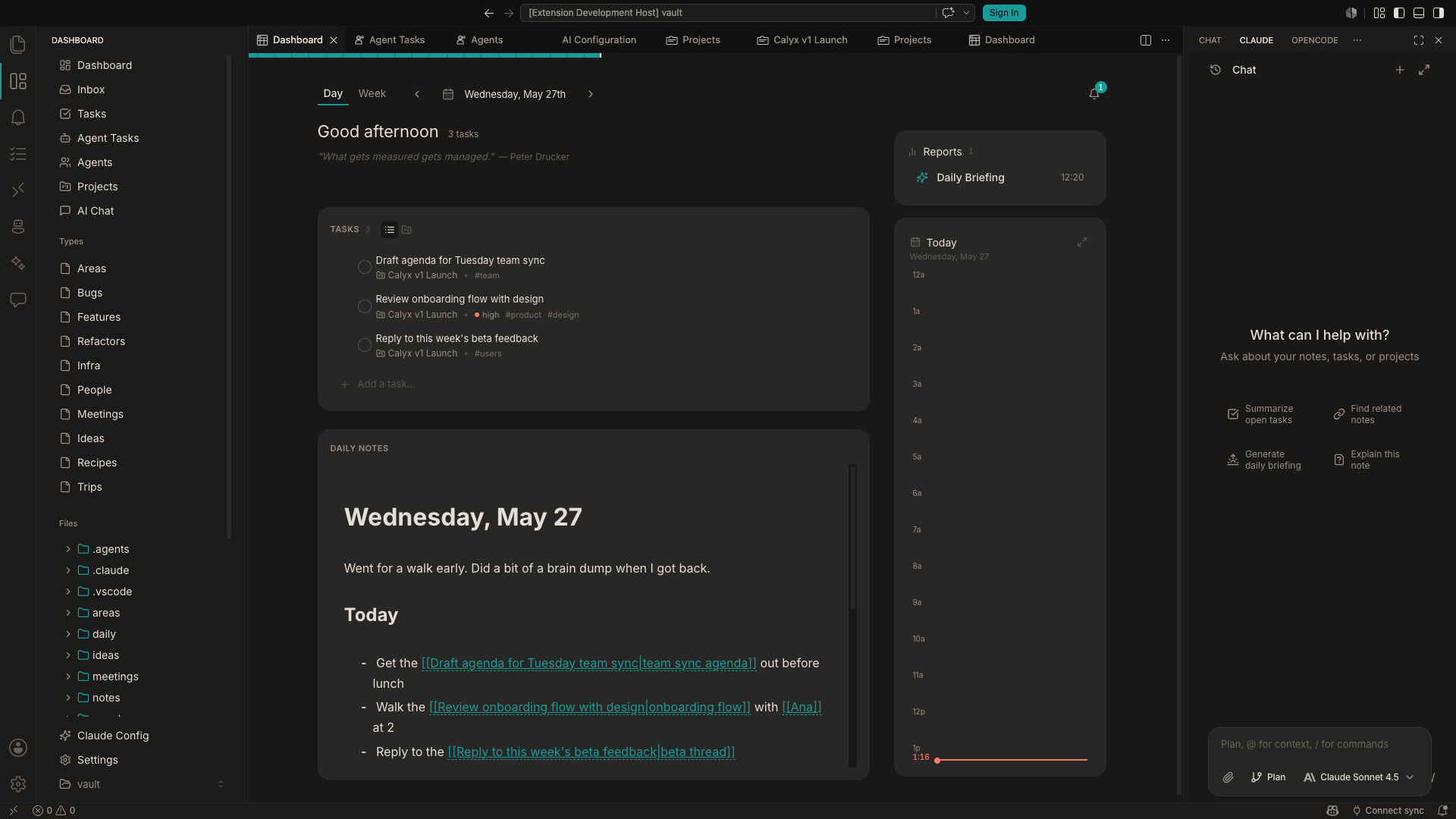
Tasks, projects, kanban boards, documents, dashboards, and a living knowledge base — all in one place, instead of scattered across Linear, Notion, Google Drive, and six chat windows. No constant tab-switching, no copying things between tools that don't talk to each other.
And it's all just files. Every task, project, and note is a plain folder with a markdown file inside, and its status, owner, and links live in simple YAML frontmatter at the top. Nothing hides in a proprietary database. The PM, the founder, the ops person, and the engineer all work against one source of truth — and so does the AI.
A living system
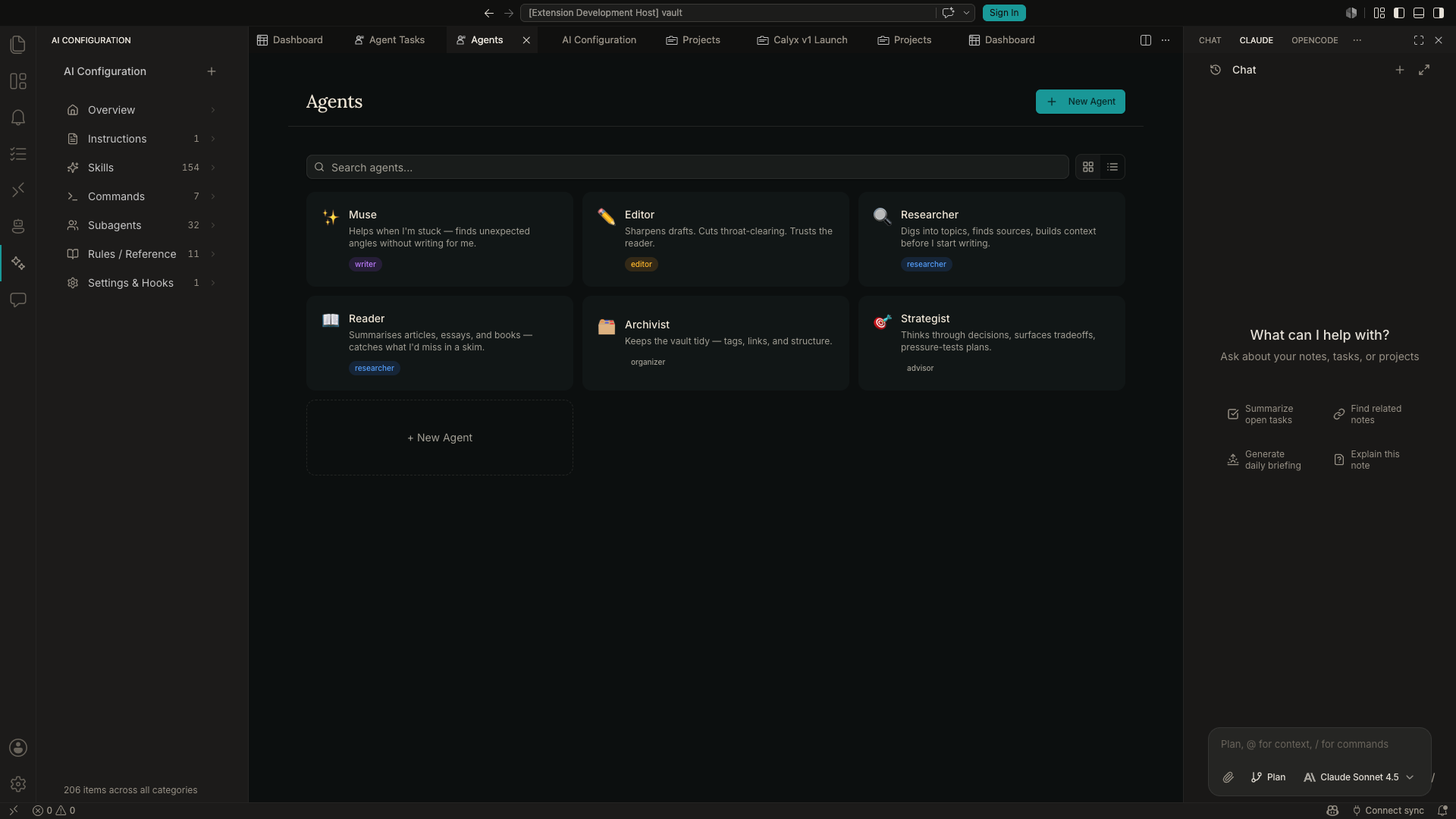
Most workspaces are somewhere your work goes to sit. Calyx does things with it. Connect it to the tools you already use — anything with an API or MCP — and it becomes a home base that can act: pull live data from your calendar, inbox, or analytics, and have an agent check it and do something about it.
Background agents keep things moving while you're not looking — triaging incoming support queries as they land, generating the weekly report, drafting replies in your inbox. The documentation keeps itself current too: point an agent at your work and it writes and updates the docs as things change, so they stop rotting the way every wiki does the moment everyone gets too busy to touch it. The whole thing stays current on its own.
It works whether you're one person or twenty
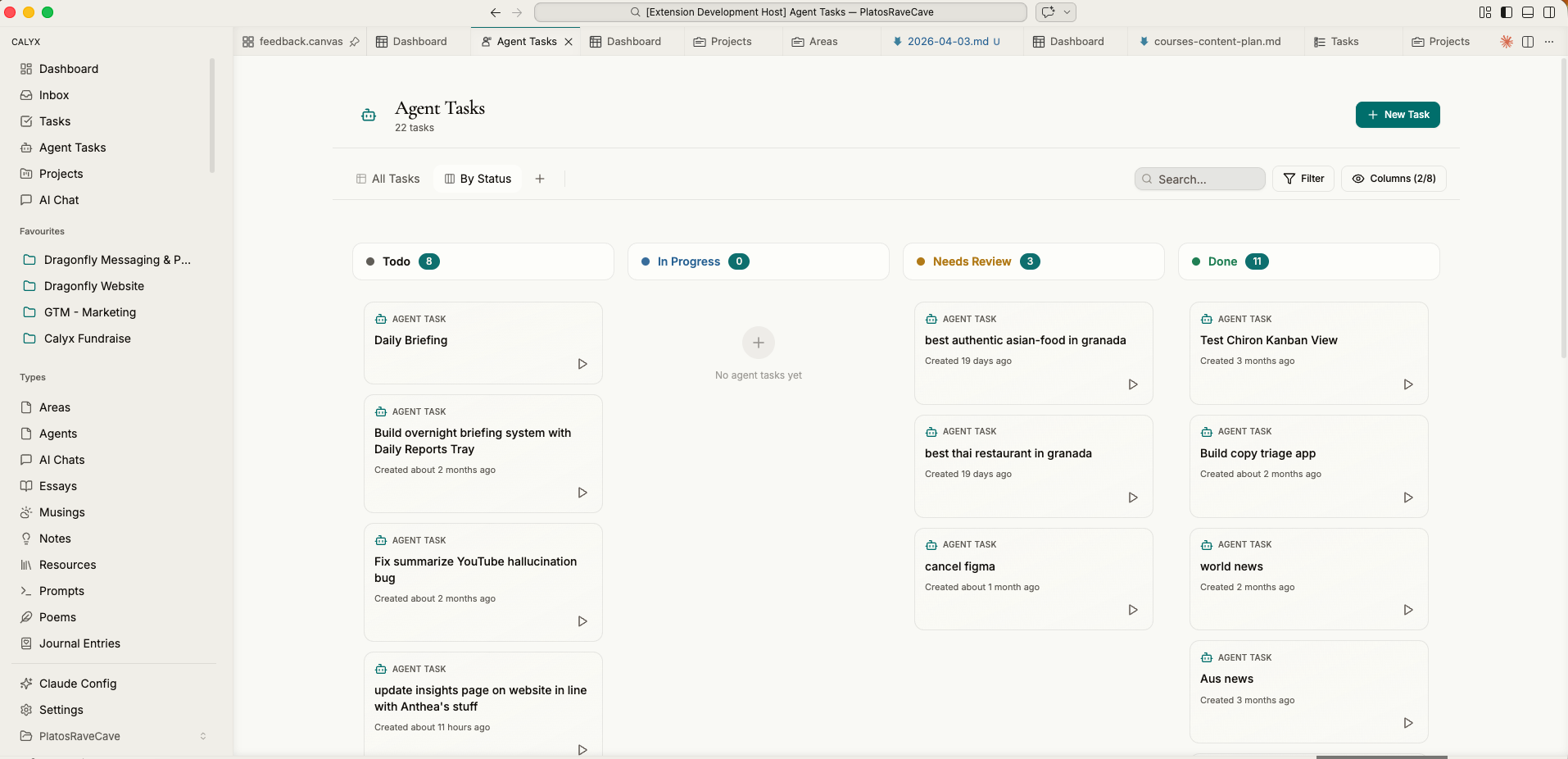
This is how we run Calyx. When you're a small team — or a company of one — you wear every hat, and the gap between the work that needs doing and the people to do it is enormous. Background agents close that gap. You hand work to an agent the same way you'd hand it to a teammate: allocate a task, set it to recur if you want, and it executes end-to-end inside the workspace — with full context of your projects, your docs, and your data.
This is how you stay lean: lean on agents as much as you can, hire slowly and deliberately, and let a tiny team punch far above its weight.
Stop renting your stack
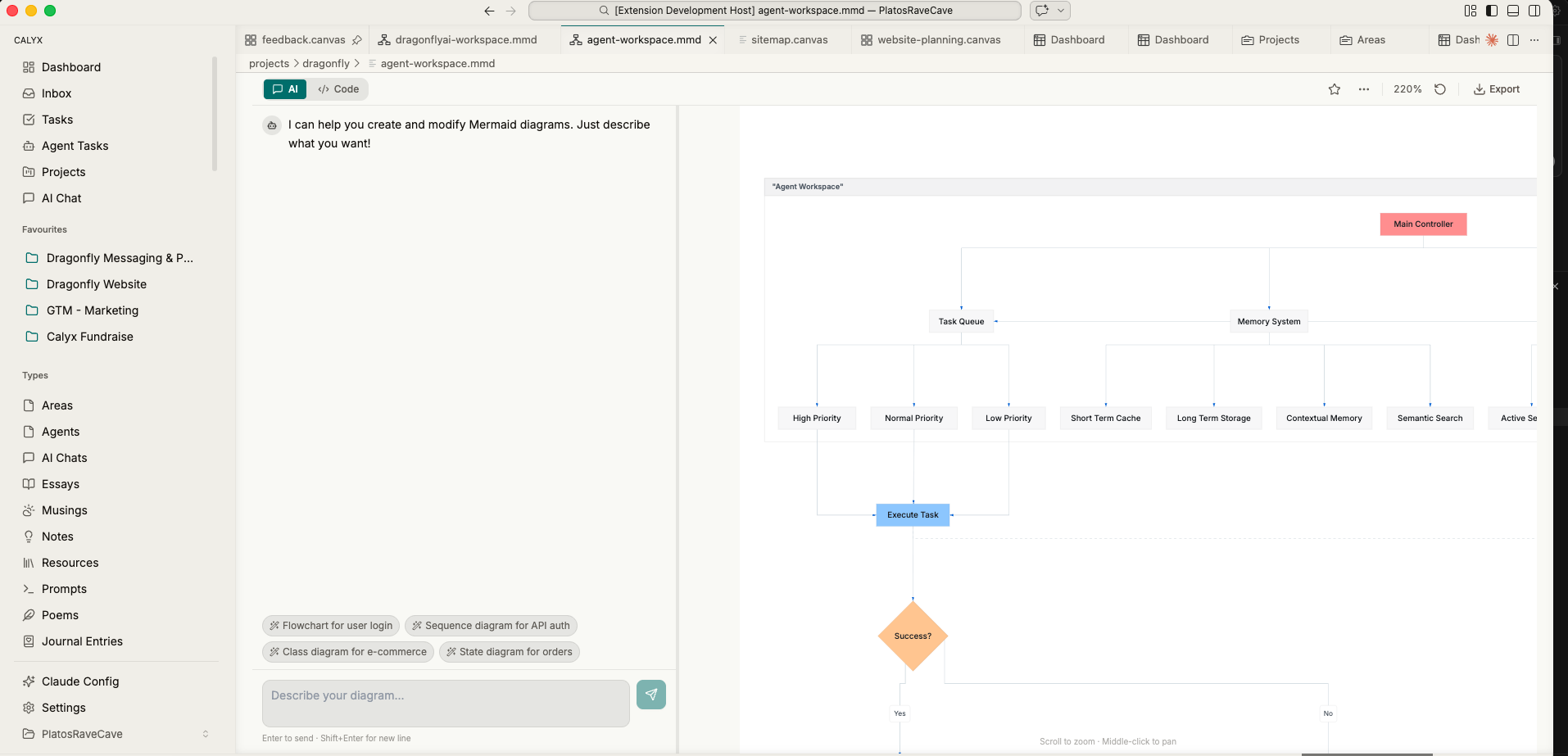
A reckoning is coming for SaaS. Apps that charge $20/month for narrow functionality are getting vibe-coded out of existence — and the "company OS" no longer has to mean stitching together a pile of subscriptions. Need a CRM? A lead tracker? A content calendar? An onboarding dashboard? You — or an agent — spin it up, and it lives inside Calyx, on top of your real data.
The value shifts from "which apps do we subscribe to?" to "the environment that lets us make our own." You're not competing with individual SaaS tools anymore. You're making them optional.
Bring your own agents — and your own infrastructure
BYO everything: keys, models, agents. No lock-in to any provider — the best model today won't be the best model in six months, and you shouldn't have to switch workspaces to switch providers. Use Claude Code, Codex, Droid, whatever you like.
And because Calyx is a fork of VS Code, a company can point it at its own private servers for hosting cloud agents like OpenClaw and Hermes. Your agents, your infrastructure, your data — which starts to matter a lot the moment there's real compliance and real client data involved.
Everything in one window
Project management, tasks, kanban, docs, dashboards, and knowledge — one workspace on top of plain files, not a dozen disconnected tools.
A team of agents
Allocate work to background agents, including recurring tasks. They execute end-to-end with full context — so a small team runs like a big one.
Connected & alive
Plug into anything with an API or MCP, act on live data, and let agents keep your docs and reports current automatically. A home base that works on its own.
Make your own tools
Vibe up the CRM, tracker, or dashboard you actually need. It lives inside Calyx on your own data — no new subscription.
Your data, your infra
Local-first, BYO keys and agents, and the option to run cloud agents on your own servers. No vendor lock-in, no black box.